
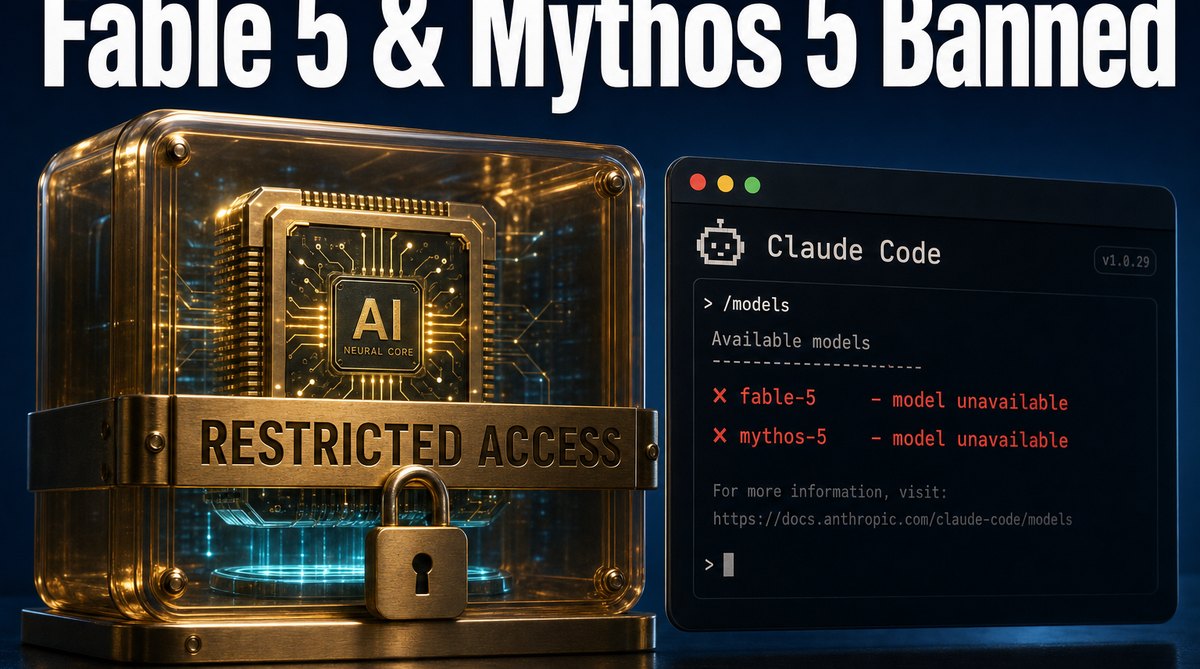
Claude Fable 5 and Mythos 5 were disabled three days after launch when the US government ordered Anthropic to suspend access for all foreign nationals. Opus 4.8, Sonnet, and Haiku still work, so the fix for most stacks is a one-line model swap plus a fallback.
Three days. That is how long Claude Fable 5 was generally available before the US government ordered Anthropic to pull it. If you wired Fable 5 into a workflow this week and woke up to failing calls, you are not imagining it and you did nothing wrong. This was not a routine "model deprecated, migrate when you can" notice. It is the first time the US has issued an export-control directive over access to a large language model, and it landed overnight. Here is what happened, why your access vanished, which Claude models still work, and the fastest way back to a running stack.
What Actually Happened
On June 9, 2026, Anthropic launched Claude Fable 5 and Claude Mythos 5. On June 12, the US government directed Anthropic to suspend access to both models for all foreign nationals, including Anthropic's own foreign-national employees. To comply, Anthropic disabled Fable 5 and Mythos 5 for everyone while it worked out how to meet the directive. If your app called either model, those calls started failing.
The effect was blunt and immediate. There was no staged rollback or regional fence at first, just an abrupt shutoff. A team that had moved a summarization job onto Fable 5 the day it launched would have seen the pipeline throw errors mid-run by the 12th, with nothing in their own code or billing to explain it.
Why Fable 5 and Mythos 5 Specifically
The government letter did not spell out its national-security reasoning in public. Anthropic's understanding is that officials believed someone had found a way to bypass, or "jailbreak," Fable 5's guardrails, and that the bypass could expose advanced cybersecurity capabilities.
That is why the order targeted the two newest, most capable models rather than the rest of the lineup. The concern was about what a jailbroken frontier model could do, not about Anthropic's products broadly. The part worth keeping front of mind: this is the first US export-control directive aimed at LLM access, and that precedent is what developers will be living with regardless of how this specific case resolves.
Which Claude Models Still Work
Here is the part you actually need. The earlier Claude models remained available, including Opus 4.8, Sonnet, and Haiku. The directive was scoped to Fable 5 and Mythos 5, not the whole family. If Fable 5 was doing heavy reasoning for you, Opus 4.8 is the natural fallback; for high-volume or latency-sensitive jobs, Sonnet and Haiku are still there. In most pipelines the fix is a one-line model-id change plus a quick prompt sanity check.
A two-minute migration checklist:
- Swap the model id:change Fable 5 / Mythos 5 in your API calls and agent configs to Opus 4.8 (or Sonnet/Haiku for speed and cost).
- Re-test your prompts:capable models are not drop-in identical, so re-run your evals on a few real inputs.
- Add a fallback:wrap the primary model in try-primary, catch, route-to-secondary so one model being pulled never takes the product down.
- Pin a known-good model id:reference a specific model rather than "latest," so a surprise launch or removal does not shift under you.
What This Means Going Forward
The uncomfortable lesson is that model availability is now a supply-chain risk, not just a roadmap question. A model you depend on can disappear for reasons that have nothing to do with your account, your region, or your code, and it can happen in days.
That is not a reason to avoid frontier models. It is a reason to build as if any one of them could vanish. A developer who hard-codes a single model id across forty functions spends the outage doing a frantic find-and-replace; one who put "the model" behind a single config value spends five minutes. The same logic extends to everything layered on top of a model, including the skills and MCP servers your agents rely on. Portability is the hedge, and it is cheap to buy before you need it.
Browse next: How to Add Skills to Claude Code (2026) | Claude Code MCP (2026) | Claude Code vs Gemini CLI (2026) | Codex vs Claude Code (2026)
Fable 5 Ban, Answered
Is Fable 5 banned permanently?
It is suspended under a US government directive, not announced as permanent. Anthropic disabled access to comply; future availability depends on the directive, which was unresolved at the time of writing. Treat it as unavailable until officially restored.
Why were Fable 5 and Mythos 5 singled out?
They were the newest, most capable models, and the concern was a guardrail bypass (jailbreak) that could expose advanced cyber capabilities. Earlier models were not covered.
Can I still use Claude Opus 4.8, Sonnet, or Haiku?
Yes. Those remained available. The directive was scoped to Fable 5 and Mythos 5.
Does this affect Claude Code or Claude-based agents?
Only if they were specifically calling Fable 5 or Mythos 5. Point them at Opus 4.8, Sonnet, or Haiku and they keep working.
Is this a normal model deprecation?
No. This is the first US export-control directive on LLM access, a different category from a planned deprecation, and it took effect almost immediately.